
Blog
This Founding Father’s Estate Could Become Virginia’s Next State Park
December 2, 2025
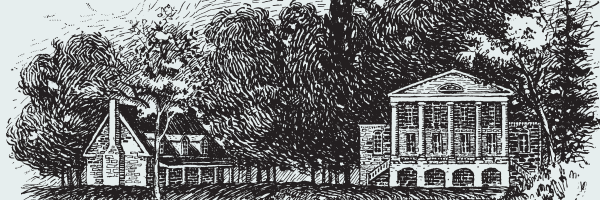
On a sprawling estate stretching across more than 1,200 acres in Aldie, Virginia lies Oak Hill, the last privately-owned residence that once belonged to an American President. Yet, Oak Hill is more than a handsome brick house perched above Northern Virginia’s rolling countryside. It is a tangible stitch in the fabric of our nation.
The estate was once home to James Monroe, our fifth president and a Founding Father whose name is entwined with the expansion and the diplomacy of the early Republic. The last in a dynasty of Virginia-born Presidents, he served his nascent nation in the years following the War of 1812 and oversaw the reconstruction of the White House, the Capitol Building and other structures throughout Washington, D.C. following the devastating fires set by the British.
Yet it is from here, at Oak Hill, that he crafted his greatest legacy as President of the United States – the Monroe Doctrine. President Monroe spent several years at this address in Loudoun County and retired here following his two terms in office.
Preserving Oak Hill as a public park would give Virginians and Americans a place to study Monroe’s life and legacy and to celebrate the commonwealth that produced so many leaders of the early United States. Recent momentum behind that idea, led by Delegate Geary Higgins and embraced by Governor Glenn Youngkin, feels like the right answer to a rare opportunity. That momentum gained significant ground in November 2025, when The Conservation Fund announced it had officially acquired the entire 1,200-acre Oak Hill estate, ensuring the property will be protected from subdivision and development while plans for a state park advance.
The construction of Oak Hill was a massive undertaking. Prior to James Monroe’s ownership in 1808, the estate boasted little more than a simple dwelling and the outbuildings on the working farm, many of which could be dated back to when the land was originally granted to Lord Fairfax in 1724.
It was not until the British burning of Washington in 1814 that James Monroe decided to transform the property he inherited from his uncle into a fine country house. At the time, Aldie was a full day’s carriage ride from Washington D.C. and provided enough distance for him, his wife, and their two daughters to reside outside of the city.
Over the course of three years, Monroe poured his finances into the project. By 1823 he had a magnificent home, but a dwindling bank account.
During his time in Loudoun, he was active in the production and trade of his crops. A ledger from the time even bears his name at the nearby Aldie Mill where he was a regular customer.
Tragically, Monroe was forced to sell Oak Hill a mere seven years after its completion. By that time he had already sold off his other properties in Virginia, but he still did not have the funds to keep this estate.
A year later he wrote to James Madison from where he lived with his daughter in New York that, “It is very distressing to me to sell my property in Loudoun, for besides parting with all I have in the State, I indulged a hope, if I could retain it, that I might be able occasionally to visit it, and meet my friends, or many of them, there.”
Within Oak Hill’s rooms and on its lands lie threads that connect to the Monroe Doctrine, to discussions between Jefferson and Monroe about architecture and republic-building, and to quieter domestic histories that shaped the man who led the country during the so-called “Era of Good Feelings.” For too long Oak Hill has remained privately held while its stories sat largely inaccessible to the public. Turning that estate into a place where students, historians, and families can walk the very fields Monroe walked is not mere nostalgia, it’s civic education.
Delegate Geary Higgins’ advocacy has helped convert local concern into political traction. Higgins has been a consistent voice for preserving Oak Hill, working with community leaders, conservation organizations, and the property’s current owners to explore a path that protects the landscape and interprets its layered histories.
The most recent development is consequential: Governor Youngkin has pledged to include the Oak Hill State Park plan in his final budget proposal to the General Assembly ahead of the 2026 session. In the meantime, The Conservation Fund—now the official steward of the property—has begun managing and securing the estate, hiring a property manager and overseeing maintenance while coordination with the Commonwealth continues.
Governor Youngkin stated, “I have been so excited about this project since we first started talking about it, and I am giving my commitment, today, that I will include in my introduced budget in December, authorization for the state to fund its portion of acquiring this historic property and establishing a new State Park in Northern Virginia.”
That commitment signals a willingness at the executive level to invest in preserving a site that belongs to more than one neighborhood or one family — but to the commonwealth.
Delegate Geary Higgins reaffirmed his commitment to the project, sharing, “True to my word, I did not give up on Oak Hill, and now with Governor Youngkin’s commitment, we can be sure it will be back next session. I hope my Democrat colleagues in the Virginia General Assembly will do the right thing: support Oak Hill and preserve this piece of history for future generations.”
Though centuries have passed since James Monroe called Oak Hill and Loudoun County home, his legacy is still evident in both the house he loved and the nation he served.
Virginia is, by any measure, a cradle of early American leadership: presidents, thinkers, and activists walked these hills. Oak Hill, with its architecture influenced by Jeffersonian ideas and with physical traces of both prominent visitors and nameless laborers, offers a classroom that textbooks alone cannot provide. With The Conservation Fund’s acquisition now securing the estate’s future and preparations underway for its eventual transfer to public ownership, the possibility of Oak Hill becoming Virginia’s next state park feels more tangible than ever.